
Brisbane 2032 and the 0.021%

Inside the Brisbane 2032 offices, a gold lettered wall reads, “Celebrating our Athletes.” Beneath it sit the signatures of a small portion of the 4,554 Olympians and 1,125 Paralympians who have ever represented Australia. Together they account for just 0.021 percent of the population.
Last week, Aussie legend of mogul skiing, Brodie Summers OLY and I added our names to that wall, a moment of pride and gratitude as I look back on my own career, but also a moment of reflection for whats ahead. Standing there, I was struck not only by what that 0.021 percent represents in terms of discipline, resilience and applied performance, but by how visible excellence can sometimes obscure the systems that enable it.
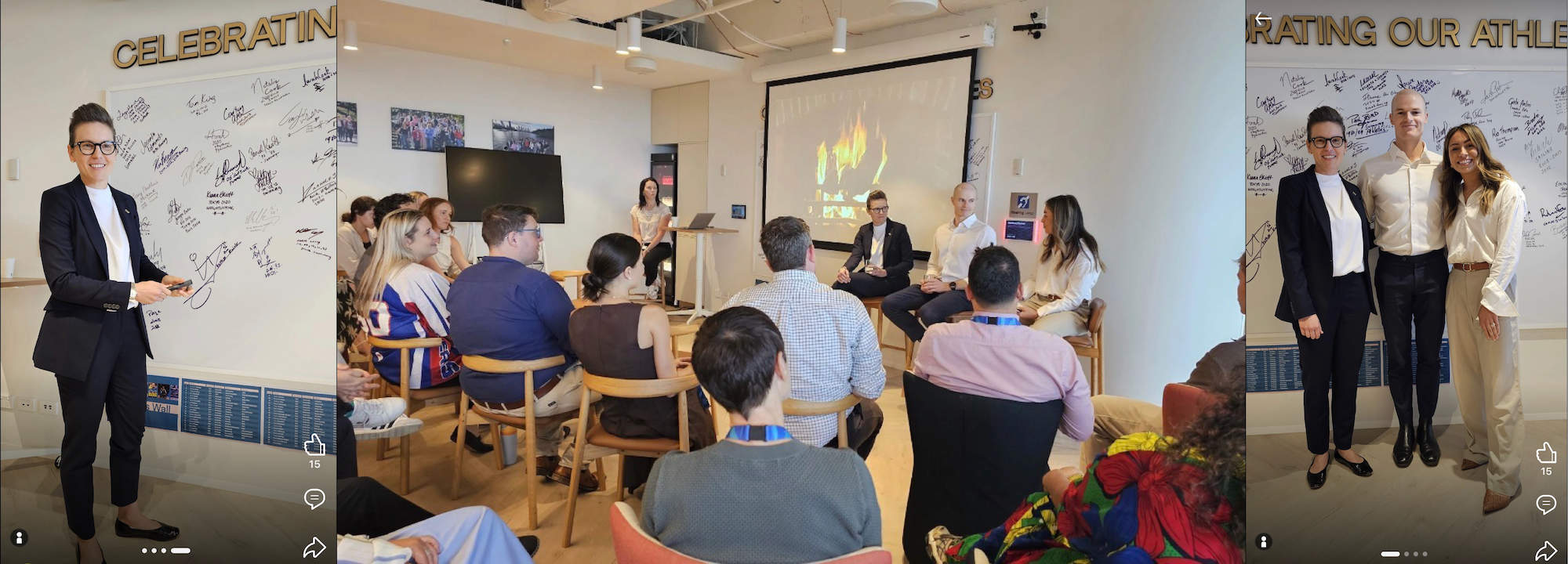
Image: Brisbane 2032 Offices, January - 2026
Elite outcomes are rarely isolated achievements. They are the product of coordinated ecosystems that evolve over time.
That perspective shapes how I think about Brisbane 2032.The Games feel less like a standalone event and more like an inflection point. Not because they automatically transform a nation, but because they create conditions where integration becomes more intentional.Australia consistently produces high quality research, capable institutions and entrepreneurial talent.
Yet according to the OECD’s Main Science and Technology Indicators, Australia’s gross domestic expenditure on research and development as a percentage of GDP remains below the OECD average and well behind leading innovation economies such as Korea, Israel and the United States (OECD, 2023).
The issue is not creativity or intelligence. It is often translation. We generate strong ideas and globally respected research, but the pathway from capability to scaled impact can remain wider than it needs to be.Im convinced, moments of national coordination can narrow that gap if theyre done right.
I am no expert on Korean innovation policy, but who among us does not have a Samsung device nearby? Few people realise that South Korea invests close to 5 percent of its GDP in research and development, placing it among the most research intensive economies in the world.
That alignment between research intensity and industrial scale isnt incidental.When timelines are fixed and expectations are shared, collaboration becomes more deliberate. Institutions that might otherwise work in parallel are brought into closer proximity.
The opportunity is not simply to deliver well, but to learn intentionally and embed what proves effective.Elite sport offers a useful lens. Living inside high performance systems reveals that excellence is rarely about intensity alone. It is about clarity, disciplined feedback and continuous adjustment.
Athletes operate within environments that test, refine and recalibrate constantly. Coaches, scientists, analysts and support teams contribute distinct expertise, but align around shared outcomes.Those characteristics are not unique to sport. They are characteristics of effective complex systems.
The question worth considering is how much of that systems literacy we consciously carry before, throughout and beyond the Games cycle. How do we ensure that what is built for a deadline also strengthens the institutions and networks that will operate long after it?
Research into workplace motivation reinforces this broader point. Dan Pink’s work on autonomy, mastery and purpose highlights that sustained performance emerges when individuals feel trusted, capable and connected to meaningful outcomes (Pink, 2009). Large scale national efforts succeed not only because of structure, but because of engagement.
When people understand how their contribution fits into a larger capability story, commitment deepens.That distinction matters.If those contributing to Brisbane 2032 see their work not only as event preparation but as long term capacity building, the impact compounds. The immediate result may be a successful Games.
The longer term result can be stronger institutional confidence, improved cross sector integration and a workforce more comfortable operating inside complex systems.Regional Australia sits at the centre of this possibility. Regional communities have long demonstrated adaptability and resilience, often achieving more with fewer resources.
The opportunity is not to extend metropolitan thinking outward, but to ensure that whatever capability is strengthened in preparation for 2032 is accessible and relevant across diverse contexts. When innovation diffuses intentionally, productivity and social return rise together.
The gold lettered wall inside the Brisbane 2032 office celebrates concentrated excellence. It is a powerful symbol of what disciplined systems can produce.But its greater value may be as a reminder that excellence is never isolated. It is built collectively, sustained collectively and, importantly, reinvested collectively.
The 0.021 percent represent visible performance at the highest level. They are also part of the broader 99.979 percent who contribute across business, education, community and industry long after competition ends.
Elite performance does not sit outside society. It circulates back into it.Brisbane 2032 will be delivered successfully, I have no doubt. The more important question may be what national capability we build alongside it.
OECD 2023, Main Science and Technology Indicators, Organisation for Economic Co-operation and Development, Paris.
OECD 2023, Gross domestic expenditure on R&D (GERD) as a percentage of GDP, Organisation for Economic Co-operation and Development, Paris.
Pink, D.H. 2009, Drive: The Surprising Truth About What Motivates Us, Riverhead Books, New York.
Pink, D.H. 2011, The puzzle of motivation, TED Conferences, New York.